

Its customers' information was scattered across different systems. With Data4Sales, 47 Street was able to consolidate its data, gain a better understanding of each customer, and connect their experiences to deliver personalized interactions across all channels.





47 Street is a fashion retail brand with 100 stores. But it had a problem: it had all its customer information, but it was scattered across three systems that didn't communicate with each other.
Let's take Camila, a loyal customer who had been shopping at 47 Street for four years. She didn't appear in the database under the name "Camila."

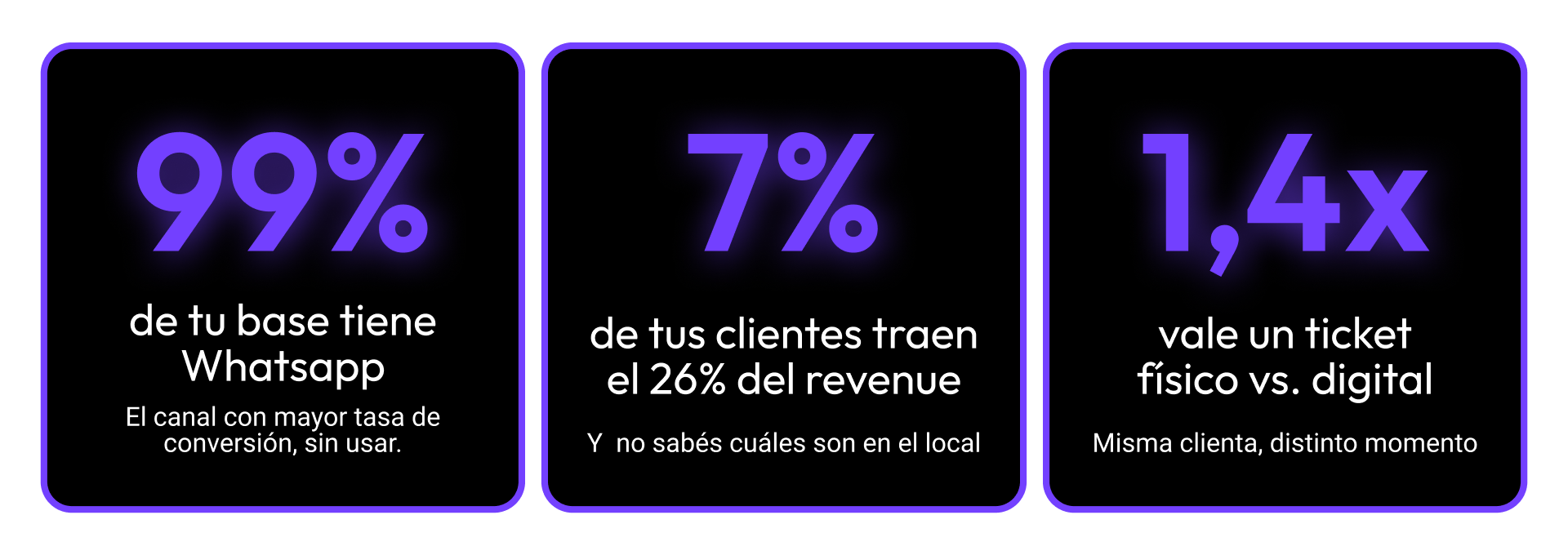
Omnichannel vs. Single-Channel Value
Customers who pick up in-store become omnichannel
Omnichannel Purchase Frequency
Each customer who began using both channels went from 1.38 to 3.09 purchases. Omnichannel retailing didn't add new customers—it increased the purchase frequency of existing customers by a factor of 2.2. However, 4 out of every 10 customers who were "acquired" in a physical store could not be engaged because their data was in the other system.
When they sent out campaigns, they sent the same email to a customer who had made a purchase the day before and to another who hadn't been seen in six months. They didn't know how many online customers had never set foot in a physical store (and vice versa). A salesperson at the physical store had no idea that a customer had left an abandoned shopping cart on the website.
Make CA + MI + LA = One Camila. Consolidate e-commerce, POS (in-store sales), and the 47 Club into a single profile. It wasn't just about combining data; it was about creating a unified context where every customer interaction made sense.
Models that predict who is about to make a purchase, who is at risk of being lost as a customer, and what product to offer them. Predictions based not on generalizations, but on Camila’s complete behavior: where she shops, which categories she prefers, when she abandons her cart, and when she is at risk of becoming inactive.
WhatsApp and email executed from the same workflow, at just the right moment. One message, one voice. Not three systems sending uncoordinated communications, but a dialogue designed end-to-end.
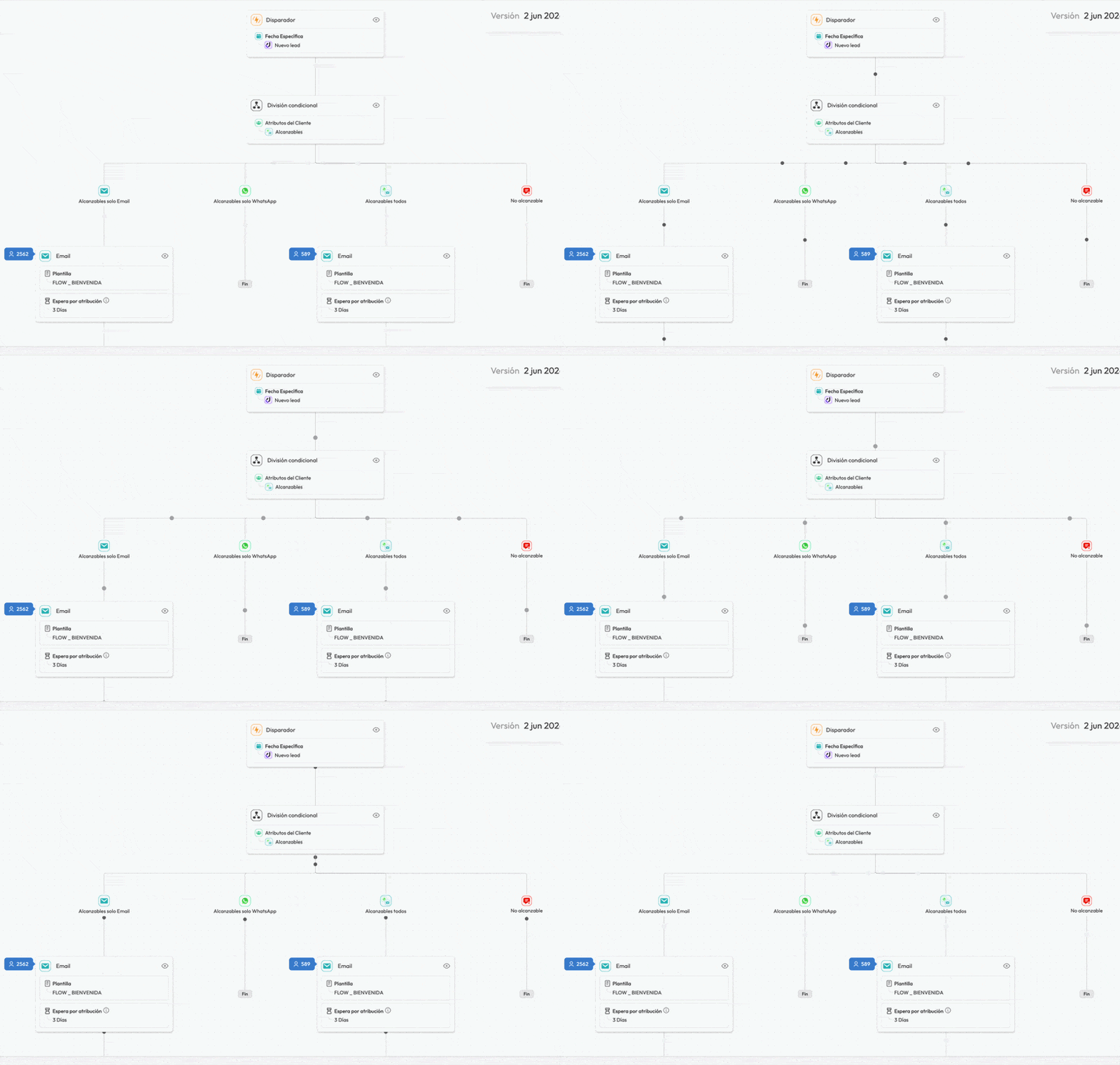
When she is added to the database, a workflow automatically begins with a personalized incentive to encourage her to place her first order.
IfCamila leaves something in her cart, they follow up with her on WhatsApp before she changes her mind. They use WhatsApp because it converts 100 times better than email. And the incentive is tailored to her profile.
Afterthe first purchase, a workflow guides her toward the second one, recommending a complementary product at just the right moment.
WhenCamila crosses the "at-risk" threshold, a cross-channel sequence is triggered to re-engage her before she becomes inactive.
Here's what changed.
3 systems, 3 names, 3 messages—none of them knew about the others.
1 profile, 1 moment, 1 message.
Now, customers receive messages that are perfectly tailored to them:
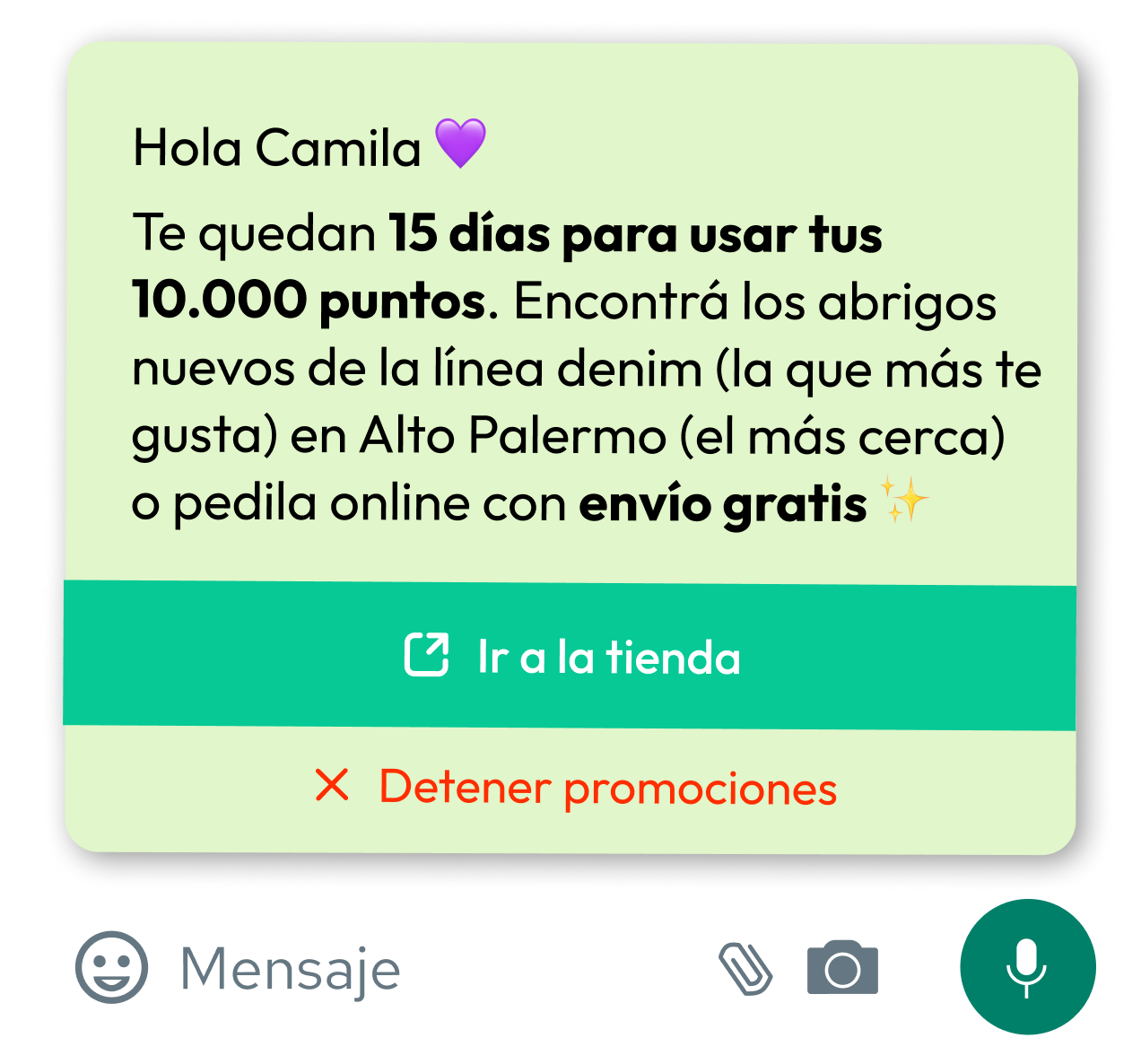
Having data is useless if it doesn't talk to itself. Most retail companies spend their time trying to gather more data. The real challenge is making it flow.
47 Street went from being completely unaware of its customers' real lives to having a full picture of them. That increased the repeat business from its best customers by a factor of 2.2. And that transformed the business.
Because, in the end, what sparks conversation isn't having more information. It's knowing how to use it.


New Customers
Recovered customers
May Buyback
Omnichannel vs. Single-Channel Value
Customers who pick up in-store become omnichannel
Omnichannel Purchase Frequency


ROAS
Revenue Generated
Conversion rate

sales growth in the industry
purchases made at a discount


hyperpersonalized
via WhatsApp

Turnover vs. previous year
Growth in recurring customers
Attribution by WhatsApp

Conversion
WhatsApp sales attribution
Record sales

Increased revenues
Recurring customer orders
Record sales


Open rate
Click rate
Bounced rate


Costs in Meta

Opening rate
Reactivation
Retention